
Experiment · Agentic AI · Memory
AI memory filters break when the labels are wrong, and no model said CONFLICT
A simulator for noisy labels, and two local models choosing between six notes about the same project.
By Muzammal Hussain · 29 October 2026 · 5 min read
An AI assistant with memory has to decide which stored note to trust: the recent one, the verified one, or the one it is allowed to use. A common answer is a gate that only lets through notes that are verified, have consent and are not out of date. I tested two things: what happens when those labels are sometimes wrong, and which note real local models pick when they read six notes about the same question.
Key findings
- My first version had a design flaw: in every question, the gate either let through two verified notes that disagree, or only a wrong one. Its 37% accuracy came from a tie-break, not from the gate.
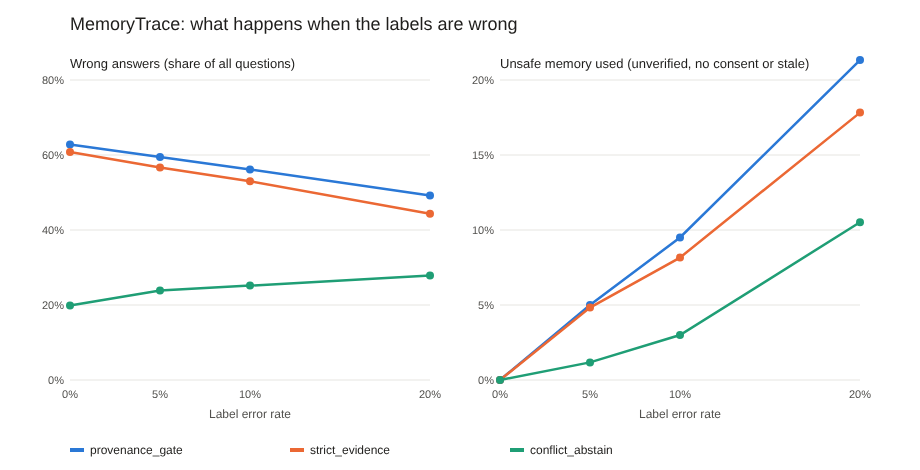
- Wrong labels leak: with 20% of labels wrong, unsafe memory got past the gate in about 21% of questions. Refusing to answer when the remaining notes disagree held it to about 10%, but answered only 44% of questions.
- A prompt rule removed the obvious risks: with it, llama3.1:8b stopped using unverified and non-consented notes (English 3 to 0, Roman Urdu 5 to 0).
- No model said CONFLICT: instead, llama3.1:8b picked the disagreeing verified note more often with the rule (6 to 8 in English, 6 to 9 in Roman Urdu). qwen2.5:3b answered "unknown" to 71 of 80 questions.
Part 1: when the labels are wrong (simulator)
The simulator has 600 questions about a project's status, each with six candidate notes: current and verified, a stale archive, a recent unverified note, a note without consent, a note about another project, and a verified note that disagrees. I flipped each label (verified, consent, current) with a set probability, let the gates decide on the noisy labels, and scored them on the true ones. I also added a third rule: answer only when every note left after the gate agrees.
| Labels wrong | Policy | Answered | Wrong answers | Unsafe memory used |
|---|---|---|---|---|
| 0% | Provenance gate | 100% | 62.8% | 0% |
| 0% | Refuse on conflict | 19.8% | 19.8% | 0% |
| 20% | Provenance gate | 81.7% | 49.2% | 21.3% |
| 20% | Strict gate | 73.0% | 44.3% | 17.8% |
| 20% | Refuse on conflict | 43.8% | 27.8% | 10.5% |
The first row is the design flaw: with perfect labels the gate never used unsafe memory, but it still answered wrongly in 63% of questions, because a verified note that disagreed always got through with the right one. Refusing on conflict exposed this: when it did answer, it was wrong, because the only note left was the wrong one.
Part 2: which note real models picked
I turned 20 of the questions into text prompts with six labelled notes and asked qwen2.5:3b and llama3.1:8b to give the status and name the note they used, or say unknown or CONFLICT. Each question ran in English and Roman Urdu, with a plain prompt and with a rule: use only notes that are verified, have consent and are at most 7 days old, and answer CONFLICT if they disagree.
| Model | Language | Prompt | Correct note | Disagreeing verified note | Unverified or no consent | Unknown |
|---|---|---|---|---|---|---|
| llama3.1:8b | English | plain | 11 | 6 | 3 | 0 |
| llama3.1:8b | English | rule | 12 | 8 | 0 | 0 |
| llama3.1:8b | Roman Urdu | plain | 9 | 6 | 5 | 0 |
| llama3.1:8b | Roman Urdu | rule | 11 | 9 | 0 | 0 |
| qwen2.5:3b | both | both | 2 of 80 | 2 | 0 | 71 |
Out of 20 questions per row. CONFLICT was never answered. qwen2.5:3b looks perfectly safe on the risk columns only because it almost never answered.
What this means
A rule in the prompt can stop a model from using notes that are clearly marked as unverified or private. It did not make the model notice that two trusted notes disagree. That check is easy in code and should live there, and the gate's labels need their own checks, because a gate is only as good as the labels it reads.
Limitations
The simulator uses hand-set distributions and flips labels independently, while real label errors are often correlated. The model test used 20 questions, two small local models, one run at temperature 0, and notes written as structured lines rather than natural text. Answers are four status words, so I scored the note each model named. No real people or records were involved.
What I will test next
- A code-level conflict check in front of the model, with real model answers.
- Notes written as natural text, where the labels have to be inferred.
Related work: Lewis, P. et al. (2020). Retrieval-augmented generation for knowledge-intensive NLP tasks. NeurIPS 2020. Packer, C. et al. (2023). MemGPT: towards LLMs as operating systems. arXiv:2310.08560. Models: Qwen2.5 3B and Llama 3.1 8B run locally with Ollama.